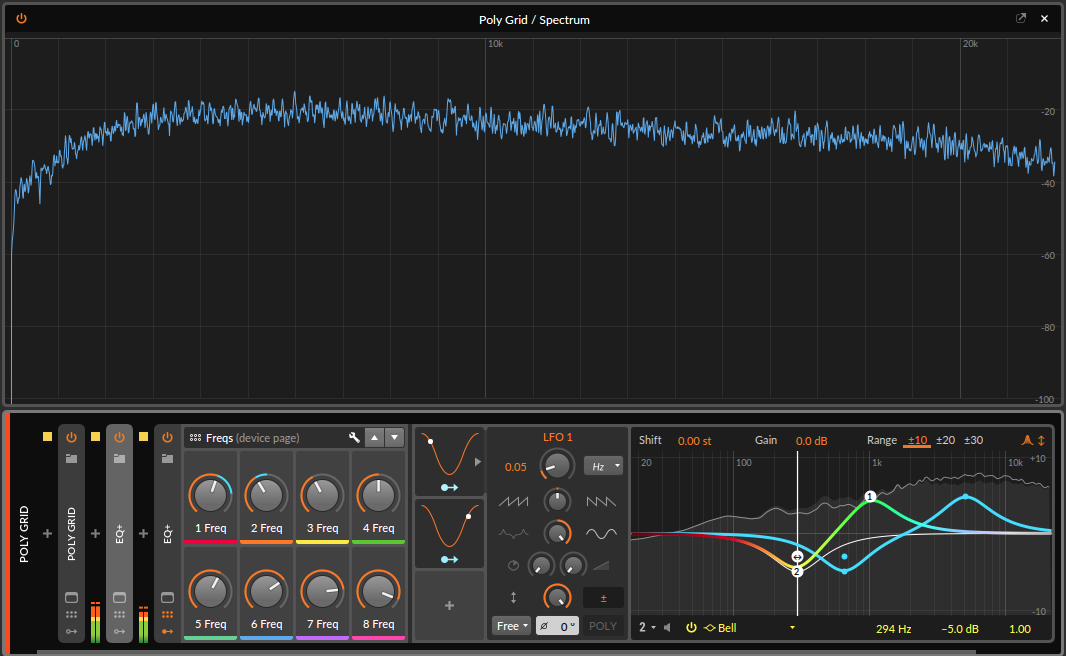
01 / Sound-design study - Bitwig Studio screenshot
Sound studies in Bitwig.
Bitwig experiments established the initial control scheme and the use of broad, slowly changing EQ bands. These studies guided the analog circuit design.
Continuous analog sound with adjustable tone and movement.
Four knobs control Body, Air, Movement, and Volume. A walnut enclosure houses the speaker and circuitry, with brass controls on the front.
Sound generated by analog circuitry, without recordings.
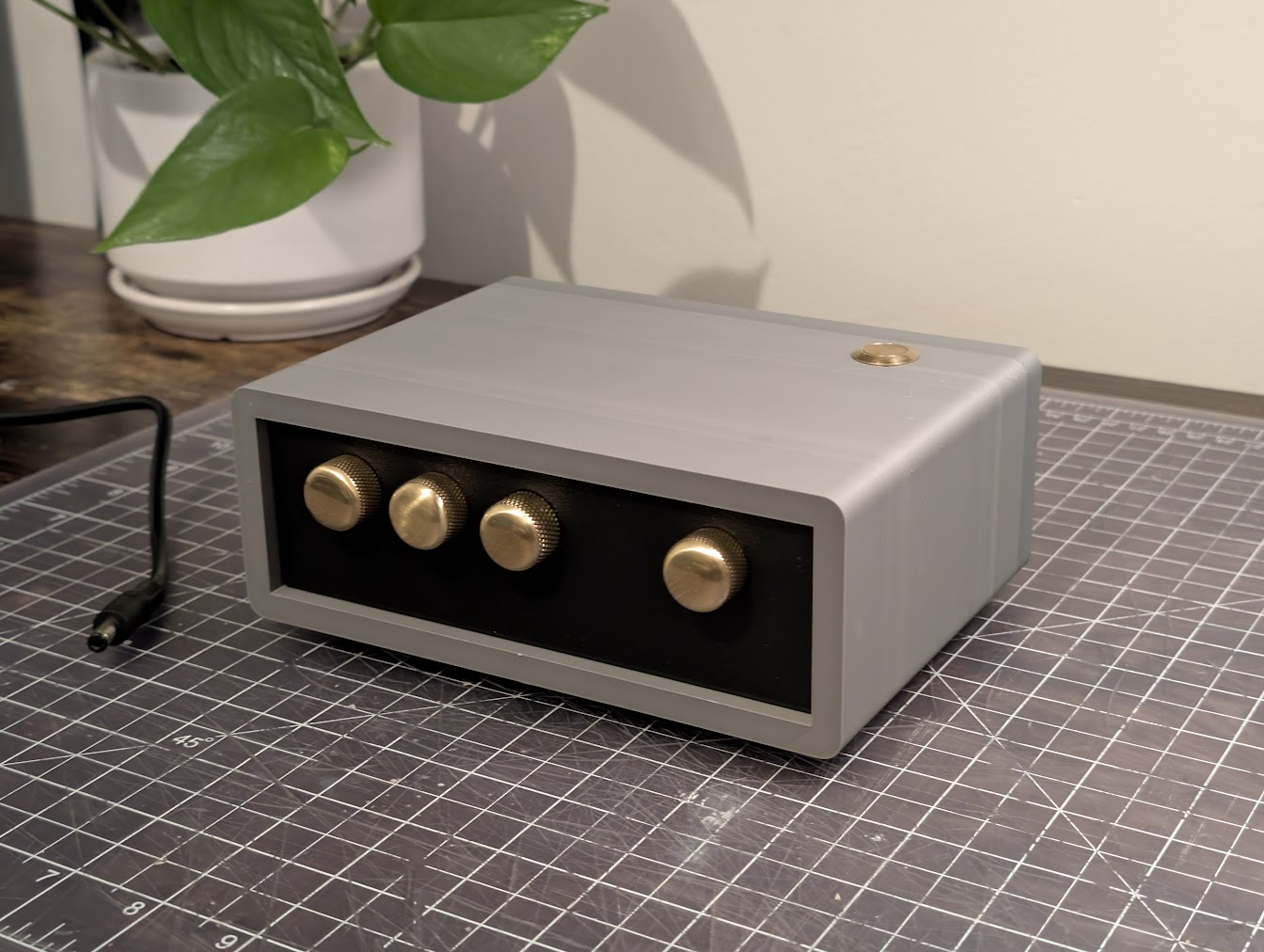
01 / The listening room
Adjust the controls while listening. The graph shows the modeled tone response and the spectrum of the playing noise.
Adjust the overall tonal balance.
Adjust the high-frequency content.
Set the depth of the moving filters.
Adjust the playback level.
The interactive sound model uses digital circuit simulations to approximate the sound of Sleep Machine’s analog circuitry. The physical sound will also depend on component tolerances, calibration, and the speaker and enclosure response.
02 / Beneath the surface
The circuit generates noise, filters it, and adds slowly changing frequency bands. Select a stage for its circuit details.
01 / Source
Sleep Machine generates noise electronically and filters it before it reaches the tone controls. The sound is continuous, with no recorded loop.
The source uses noise from a reverse-biased transistor junction. A gain stage amplifies it, and a passive resistor-capacitor network reduces high-frequency energy before the tone controls. The network approximates a pink-noise balance.
Body uses a dual-gang potentiometer: one section varies the resistance in a high-pass network, while the other adjusts the gain of the following amplifier. The gain adjustment reduces level changes as the tone changes. Because the filter loads the passive network before it, Body affects the broader tonal balance, including the treble.
Air blends two paths from the Body stage: a direct path and a path with a resistor-capacitor low-pass filter. A linear potentiometer sets the blend, and an op-amp buffer feeds the next stage. The combined response depends on the blend position; it is not a single filter with an adjustable cutoff.
Two parallel filter paths use LM13700 transconductance amplifiers, whose response is controlled by current. Analog control circuits vary their center frequencies. The paths are mixed with opposite polarity to create broad regions of emphasis and attenuation, and a dual-gang potentiometer adjusts their contribution to the dry signal.
03 / Build notes
Sound studies, circuit design, and physical prototypes shaped the controls and enclosure.
01 / Sound-design study - Bitwig Studio screenshot
Bitwig experiments established the initial control scheme and the use of broad, slowly changing EQ bands. These studies guided the analog circuit design.
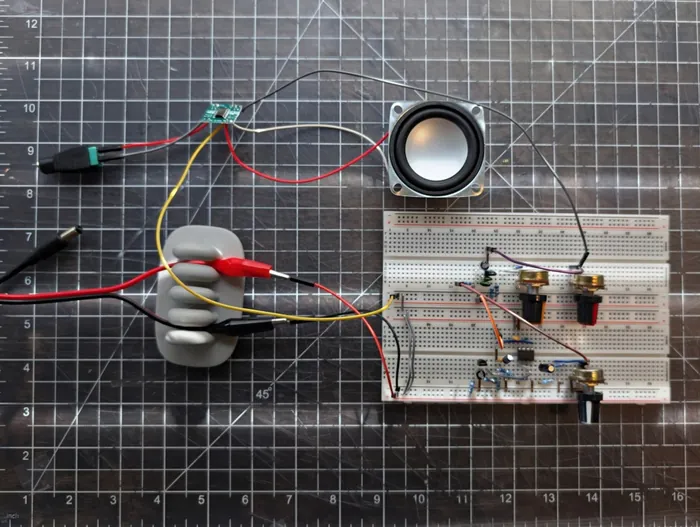
02 / Physical prototype - studio photograph
The breadboard prototype combined a transistor noise source, filters, and a speaker for listening tests. Breadboard Studio mapped connections and supported simulation and assembly.
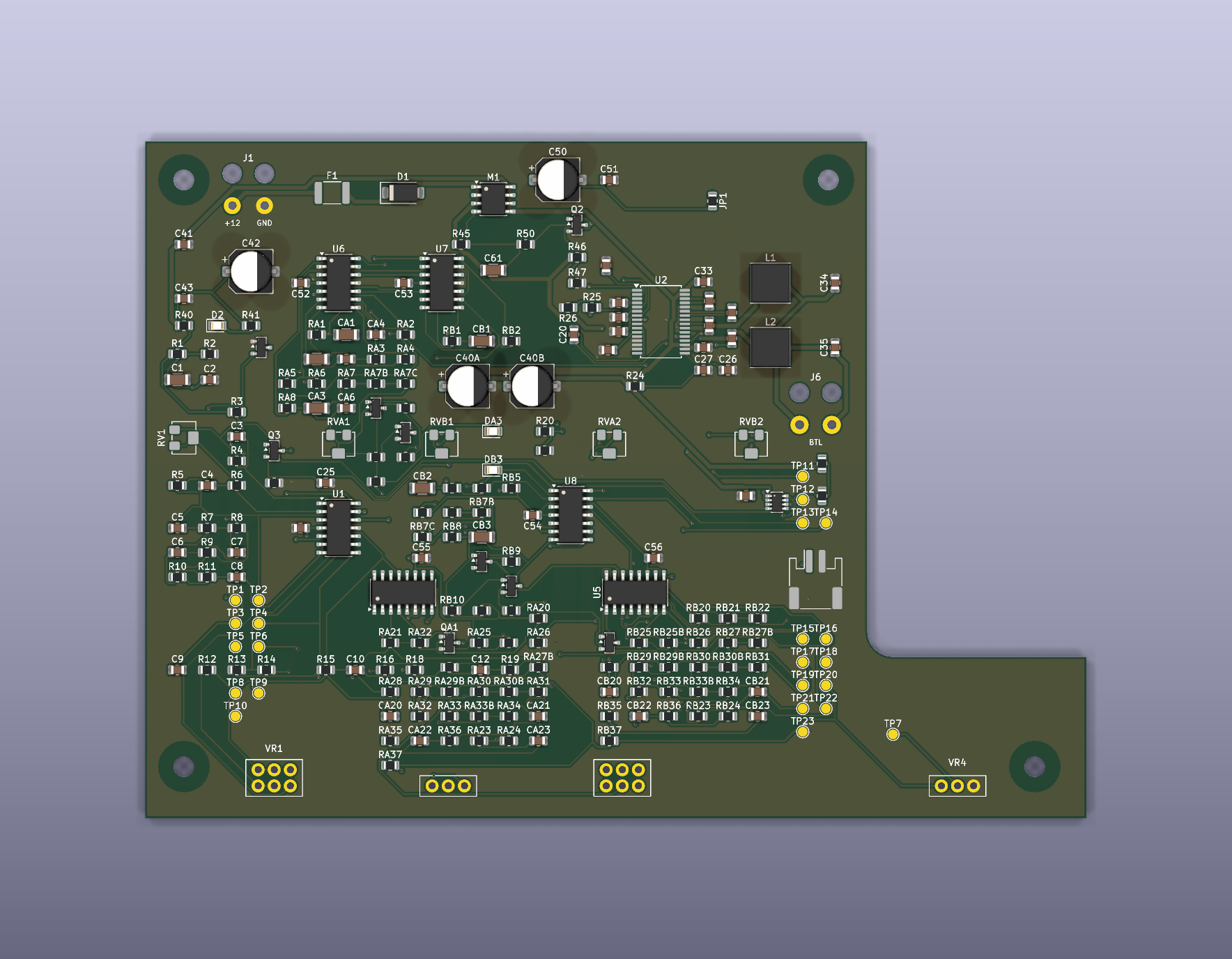 Inspect board ↗
03 / Circuit board - KiCad render
The circuit board fits around the speaker and controls. It brings the noise source, filters, amplifier, and power latch into a single assembly.
 View cutaway ↗
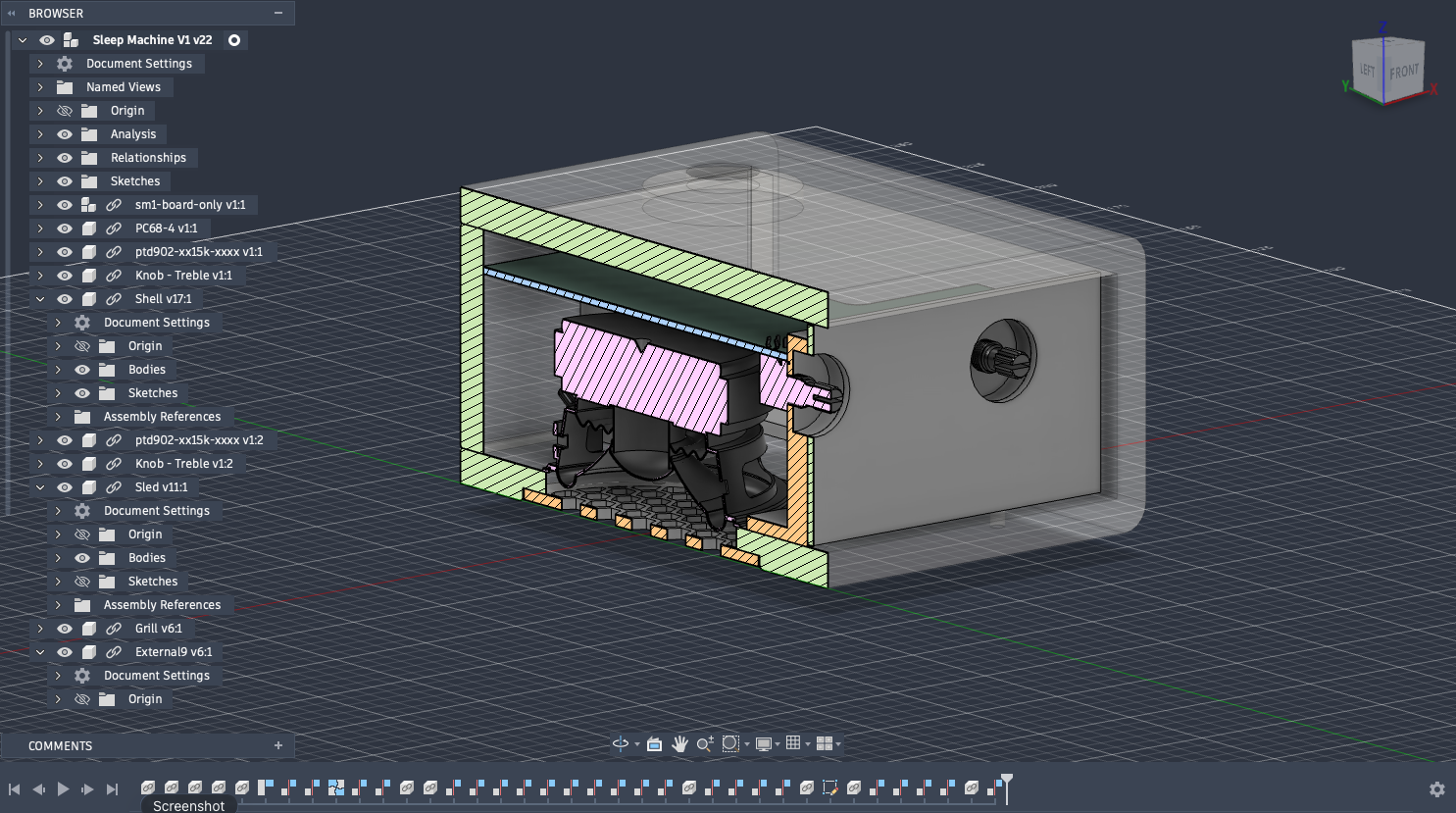
04 / Enclosure design - CAD cutaway
The enclosure arranges the controls within reach and houses the speaker, circuit board, and wiring. Physical prototypes helped establish the proportions, control spacing, and button access.
04 / Product details
Project updates
Sign up for Sleep Machine build notes and release updates.